
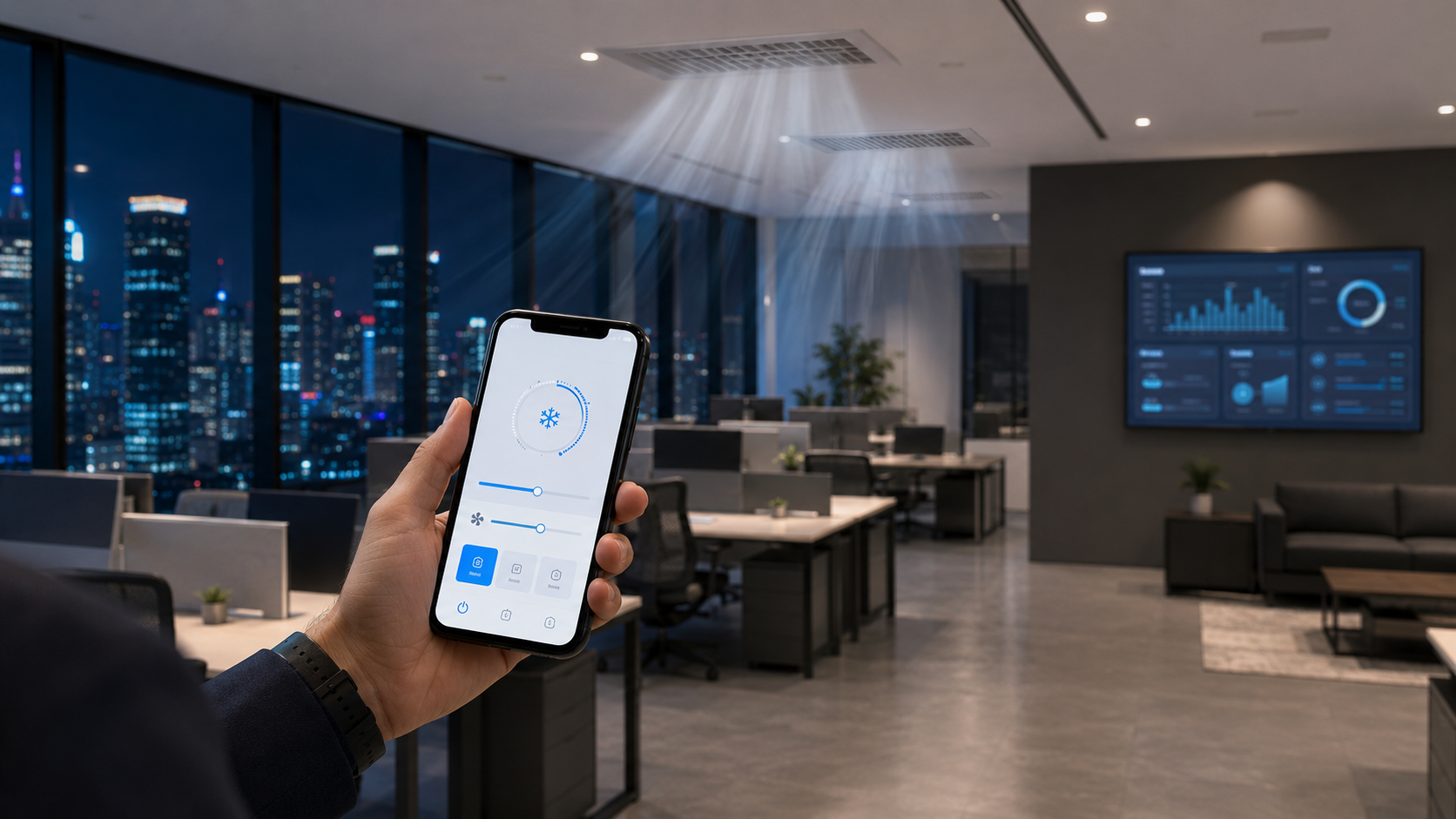
If you manage or lease commercial space, you’ve probably seen the same service called three or four different things — overtime HVAC, after-hours HVAC, on-demand HVAC, AHAC — and wondered whether they’re actually different. The short answer: they’re not. These are regional and market variations for one service: conditioning a tenant’s space outside the building’s normal operating hours, billed at an agreed hourly rate.
There is one distinction that genuinely matters, though, and it trips up a lot of people searching online. “After-hours HVAC” can also mean emergency repair work — and that’s a completely different service. This guide sorts out every term so you know exactly what you’re dealing with, whether you’re drafting a lease, comparing software, or just trying to understand a line on an invoice.
The short answer
All of these terms describe the same thing — a commercial tenant booking heating or cooling outside core building hours and paying for it by the hour:
- After-hours HVAC
- After-hours air conditioning (and the shorthand “after-hours air con”)
- AHAC
- Overtime HVAC (and “OT HVAC” or “overtime air”)
- On-demand HVAC
- Tenant overtime HVAC
The service works the same way regardless of the label: the tenant requests conditioning for a specific date, time and duration; the building runs the equipment for that window; and the tenant is billed for it separately from their normal rent and operating expenses.
Why does one service have so many names?
Mostly geography and habit. The terminology splits along regional lines and along who’s doing the talking.
In the U.S. market, “overtime HVAC” and “on-demand HVAC” are the most common terms. You’ll hear building engineers and property managers shorten “overtime” to “OT,” as in an “OT HVAC request” or “ordering overtime air.” Several of the larger U.S. proptech platforms brand the service as “On-Demand HVAC,” which has pushed that phrasing into wider use.
In Australia, New Zealand and the UK, “after-hours HVAC” and “after-hours air conditioning” dominate, and leases frequently use the acronym AHAC. Because so much of the underlying lease language refers to “air conditioning” specifically, you’ll also see “after-hours air con” in correspondence.
None of these are technical distinctions. A lease in Sydney and a lease in Chicago can describe identical service obligations using entirely different vocabulary. If you’re trying to match a term in your lease to what your building actually provides, our complete guide to what after-hours HVAC is lays out the full picture.
Term by term
After-hours HVAC / after-hours air conditioning / AHAC. The most common phrasing outside North America. “After-hours” refers to any time outside the building’s normal operating hours — typically evenings, weekends and public holidays. AHAC is simply the lease acronym for “after-hours air conditioning.”
Overtime HVAC / OT HVAC / overtime air. The dominant U.S. equivalent. “Overtime” frames the service from the building’s side — the equipment is running beyond its scheduled hours, the same way staff work overtime. Functionally identical to after-hours HVAC.
On-demand HVAC. A more modern, software-driven framing that emphasizes the tenant’s ability to request conditioning instantly, without advance notice. The “on-demand” label usually signals an automated booking system behind it rather than a manual, notice-based process — but the service itself is the same.
Tenant overtime / tenant overtime system. “Tenant overtime” centers the tenant as the party requesting and paying for the service. A “tenant overtime system” specifically refers to the software platform that automates the scheduling and billing of these requests. We cover that in what a tenant overtime system is.
The one distinction that actually matters: overtime conditioning vs. emergency repair
Here’s the trap. Search “after-hours HVAC cost” and most of what you’ll find is about emergency repair service — an HVAC contractor coming out at 9 p.m. on a Sunday to fix a failed rooftop unit, billed at an overtime labor premium. That’s a real service, but it has nothing to do with the tenant-overtime meaning used in commercial leases.
The two are easy to tell apart once you know to look:
- Tenant overtime / after-hours conditioning is a scheduled, planned service. A tenant knows they’ll be working Saturday, books the air conditioning in advance, and pays an hourly rate set in their lease. The equipment is healthy; it’s just running outside its normal schedule.
- Emergency or after-hours HVAC repair is unplanned break-fix work. Something failed, a technician is dispatched outside business hours, and the charge is a labor premium for the call-out — not a per-hour conditioning rate.
If you’re a property manager looking to charge tenants for evening or weekend air conditioning, the tenant-overtime meaning is the one you want. The repair meaning is a different industry entirely.
Not the same thing: supplemental cooling
One more term worth separating out. “Supplemental cooling” (sometimes “supplemental HVAC”) refers to dedicated equipment installed to cool a specific high-load space around the clock — most often a server room, data closet or lab. It runs continuously by design, independent of the building’s main system and schedule.
That’s the opposite of after-hours HVAC, which is about running the building’s system outside its normal hours on request. If a tenant needs 24/7 cooling for equipment, that’s a supplemental cooling conversation, not an overtime one.
The name doesn’t change how it works
Whatever your market calls it, the mechanics are consistent. The tenant requests conditioning for a defined window. The building’s management system runs the relevant equipment for that floor or zone. The tenant is billed at an hourly rate — covering electricity, equipment wear and an admin component — separately from their base rent.
What does change is how smoothly that process runs. A manual, notice-based program and an automated, on-demand one deliver the same air but produce very different results for staff time, billing accuracy and tenant satisfaction. If the terminology brought you here, the practical next questions are usually what a fair after-hours HVAC rate looks like and how to write the service into a lease.
Frequently Asked Questions
Is overtime HVAC the same as after-hours HVAC? Yes. They’re two names for the same service — conditioning a commercial tenant’s space outside normal building hours, billed by the hour. “Overtime HVAC” is more common in the U.S.; “after-hours HVAC” is more common in Australia, New Zealand and the UK.
What does AHAC stand for? AHAC stands for “after-hours air conditioning.” It’s the acronym most often used in commercial leases to describe heating and cooling supplied to a tenant outside the building’s operating hours.
What’s the difference between after-hours HVAC and emergency HVAC repair? After-hours HVAC is planned, scheduled conditioning a tenant books in advance and pays for at an hourly rate. Emergency HVAC repair is unplanned break-fix work performed outside business hours, billed at a labor premium. Despite the similar-sounding names, they’re unrelated services.
What is on-demand HVAC? On-demand HVAC is after-hours conditioning that a tenant can request instantly, usually through an automated booking platform, without the advance notice traditionally required. The “on-demand” label typically signals software-driven scheduling rather than a manual process.
Is supplemental cooling the same as after-hours HVAC? No. Supplemental cooling is dedicated equipment that runs continuously to cool a specific high-load space like a server room. After-hours HVAC runs the building’s main system outside its normal hours on request.
7NOX lets tenants book after-hours air conditioning — whatever your building calls it — straight from a smartphone or browser, with automated billing and integration into your existing building management system. See how it works.