
“Your building was born before Wi-Fi—can it still think in real time?“
This question confronts facility managers, property owners, and engineers across America as they grapple with an aging commercial building stock that predates the digital revolution. The statistics paint a clear picture: more than 50% of U.S. commercial buildings were constructed between 1960 and 1999, with only 25% built after 2000¹. These structures, many equipped with building management systems from the Clinton administration, now face unprecedented pressure to deliver modern performance standards while operating with decades-old infrastructure.
The convergence of aging building stock and increasingly stringent efficiency mandates has created a perfect storm. Traditional approaches to building modernization—complete system replacement—often prove prohibitively expensive and disruptive. However, a new paradigm is emerging that promises to transform how we think about building intelligence: edge-based artificial intelligence retrofits that can graft tomorrow’s diagnostic capabilities onto yesterday’s hardware.
The Performance Gap: Flying Blind in the Digital Age
Today’s facility managers operate in a challenging environment where real-time performance visibility remains limited, particularly in older buildings not designed for continuous monitoring². This lack of visibility forces them into reactive maintenance mode, fighting fires rather than preventing them. The human drama is palpable: emergency service calls at 2 AM, tenant complaints about temperature fluctuations, and energy bills that spike without warning or explanation.
Traditional building management systems from the 1990s were designed for basic scheduling and setpoint control, not the sophisticated analytics required for proactive fault detection. These systems often lack the computational power, connectivity, and data storage capabilities needed for modern diagnostics. Yet replacing them entirely represents a massive capital investment that many property owners simply cannot justify, particularly given the embedded value in existing sensors, actuators, and control infrastructure.
The emergence of automated fault detection and diagnostics (FDD) offers a compelling solution. Across 62 participants in DOE’s Smart Energy Analytics Campaign, FDD projects showed a median simple payback of 1-2 years, alongside median 9% energy savings³. More importantly, these systems provide the real-time visibility that transforms facility management from a reactive to a proactive discipline.
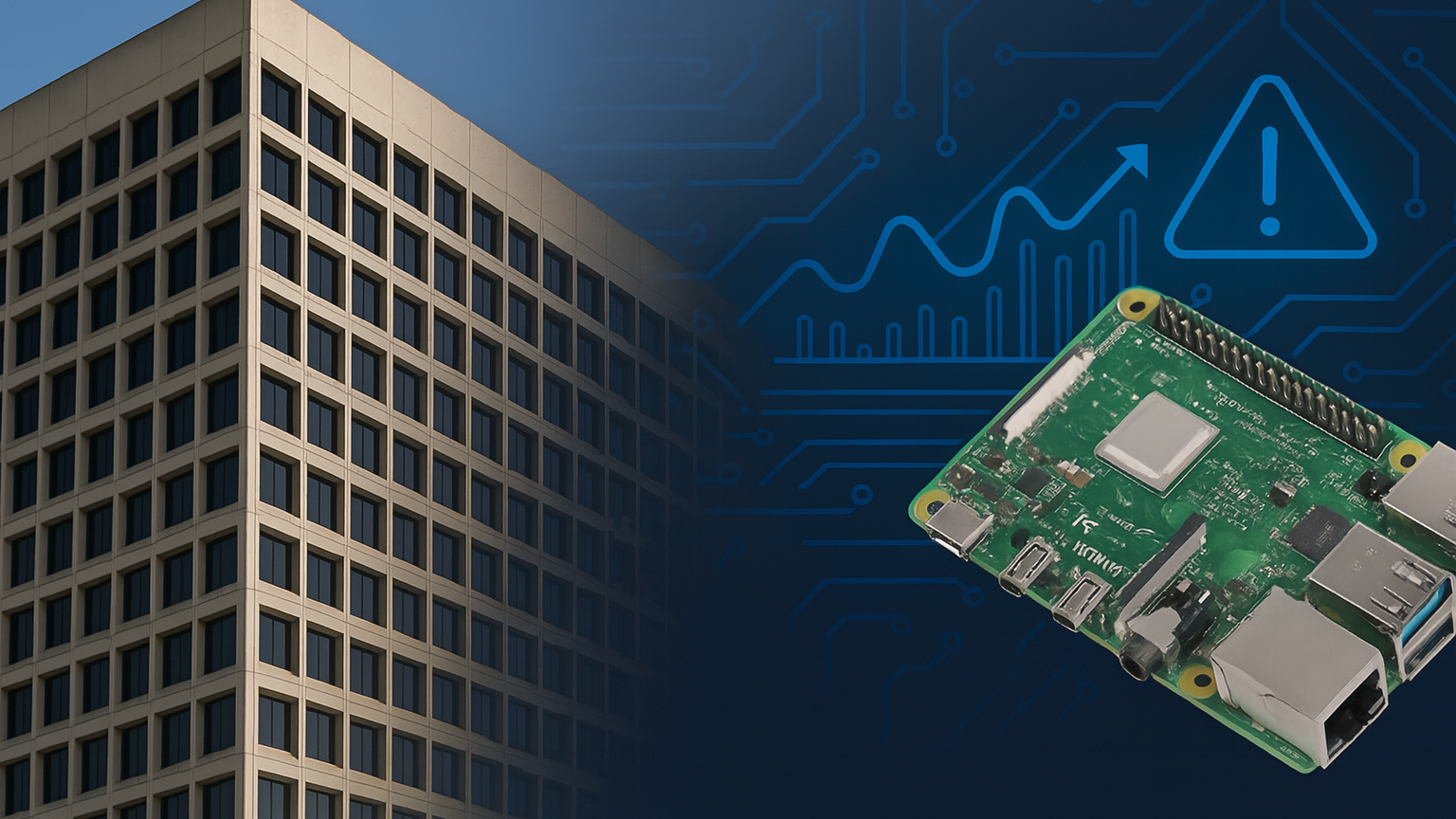
Edge AI: The Game-Changing Technology
Edge artificial intelligence represents a fundamental shift in how buildings process and act on data. Unlike cloud-based analytics that require constant internet connectivity and introduce latency, edge AI processes information locally using compact, powerful computing devices installed directly within the building infrastructure.
AI can already predict when equipment might fail, spot faults instantly and balance energy loads efficiently⁵. Modern edge computing platforms, such as the Raspberry Pi 5 ($80) or Advantech UNO-2271G ($150-200), now pack the computational power that would have required server rooms just a decade ago⁴. These Raspberry Pi-class gateways can run sophisticated machine learning algorithms locally, analyzing sensor data in real-time and making immediate control decisions without relying on external connectivity.
The technology works by establishing intelligent nodes throughout the building that monitor critical performance indicators: air handler temperatures, chilled water differential temperatures, variable frequency drive current draw, and dozens of other parameters. AI uses space usage patterns, occupancy, and weather to align HVAC demand with real-time building needs, shifting energy loads to off-peak periods to reduce costs and emissions⁶.
What makes edge AI particularly attractive for retrofit applications is its protocol flexibility. Modern edge devices can communicate using open standards like BACnet/IP and Modbus TCP, allowing them to integrate with existing building management systems without requiring wholesale replacement of control infrastructure.
Real-World Impact: From Theory to Practice
Consider a recent proprietary case study of a 1990s-era office tower that implemented an edge AI retrofit. The building’s facility management team installed four edge computing gateways strategically positioned to monitor the main air handling units, chiller plant, and critical zone controls. Within the first year of operation, this internal client project delivered measurable results: HVAC-related complaints dropped by 40%, and energy costs decreased by $0.35 per square foot.
The transformation wasn’t just about numbers—it fundamentally changed how the building operated. Previously, maintenance staff relied on tenant complaints and scheduled inspections to identify problems. Now, the edge AI system provides early warning alerts when sensors detect anomalies. A gradual increase in supply air temperature might indicate a dirty filter, while unusual current draw patterns could signal bearing wear in a fan motor. This shift from reactive to predictive maintenance not only reduces emergency service calls but also extends equipment life and improves occupant comfort.
AI aids in the monitoring and interpretation of data generated by buildings and industrial environments, optimizing energy usage⁷. The system learns normal operating patterns and can distinguish between acceptable variations (like those caused by weather changes) and genuine equipment malfunctions.

Implementation Roadmap: From Pilot to Portfolio
Successful edge AI retrofits require a systematic approach that balances technical feasibility with operational practicality. The most effective implementations begin with careful point prioritization, focusing on high-value sensors that provide maximum diagnostic insight. Air handler discharge temperatures, chilled water differential temperatures, and VFD current measurements typically offer the best return on monitoring investment.
The key to successful integration lies in leveraging existing communication infrastructure while adding modern intelligence. Most 1990s-era building management systems already use BACnet or similar protocols, making them compatible with contemporary edge devices. This compatibility allows facility managers to enhance their existing systems rather than replace them entirely.
A phased rollout approach typically works best, beginning with a pilot installation on critical equipment before expanding to building-wide deployment. This methodology allows teams to establish baseline performance metrics, validate savings calculations, and refine operational procedures before scaling the technology across larger portfolios.
The implementation process should include comprehensive data governance planning. Edge AI systems generate substantial amounts of operational data, and organizations must establish clear policies regarding data ownership, access controls, and long-term storage. These decisions become particularly important when considering the technology’s expansion potential.
Risk Management and Security Considerations
Edge AI retrofits introduce new cybersecurity considerations that facility managers must address proactively. Unlike traditional building management systems that often operated in isolation, edge AI devices typically require network connectivity for remote monitoring and software updates. This connectivity creates potential attack vectors that didn’t exist in older, air-gapped systems.
Effective security strategies include network segmentation, encrypted communications, and regular security updates. Many edge AI platforms now incorporate security-by-design principles, including hardware-based encryption and secure boot processes. However, implementation teams must also consider operational security practices, including password management, access logging, and incident response procedures.
Another critical consideration is model drift—the gradual degradation of AI performance as building operations change over time. Seasonal variations, occupancy pattern changes, and equipment modifications can all affect the accuracy of fault detection algorithms. Successful implementations include regular model validation and retraining procedures to maintain diagnostic accuracy.
Future-Proofing: Beyond Fault Detection
One of the most compelling aspects of edge AI retrofits is their expandability. Once edge computing infrastructure is installed, buildings gain a platform for hosting additional intelligent services. The same computational nodes that perform fault detection can later run occupancy analytics, demand response optimization, indoor air quality monitoring, or digital twin simulations.
This expandability transforms edge AI from a single-purpose retrofit into a foundation for long-term building intelligence. Property owners who invest in edge infrastructure today are positioning their assets for tomorrow’s smart building services, including grid-interactive capabilities, automated ESG reporting, and advanced tenant services.
Systems-based retrofit strategies have significant energy-savings potential, providing anywhere from 49% to 82% in additional energy savings⁸. As these platforms evolve, they may eventually coordinate multiple building systems simultaneously, optimizing not just individual equipment performance but entire building ecosystems.
The Path Forward
Edge AI retrofits represent more than just a technological upgrade—they offer a strategic pathway for aging buildings to compete in an increasingly efficiency-focused market. For facility managers tired of playing whack-a-mole with equipment failures, edge AI provides the visibility and predictive capability to shift from reactive to proactive maintenance strategies.
Property owners facing the choice between expensive system replacements and gradual obsolescence now have a third option: intelligent retrofits that preserve existing infrastructure investments while adding modern diagnostic capabilities. Engineers can design these systems to integrate seamlessly with current operations while providing a foundation for future enhancements.
The buildings of the 1990s may not have been born with digital intelligence, but they don’t have to remain trapped in the analog past. With thoughtful planning and strategic implementation, edge AI retrofits can help these structures think, learn, and adapt to the demands of modern facility management.
As the commercial building sector continues to evolve, the question isn’t whether aging buildings can learn new tricks—it’s whether their owners and operators will seize the opportunity to teach them.
Works Cited
- U.S. Energy Information Administration. “Commercial Buildings Energy Consumption Survey (CBECS).” 2018. https://www.eia.gov/consumption/commercial/
- Liu, Zhen, Peng Xu, Menghao Qin, and Xiaoshu Lü. “Fault detection and diagnosis for building HVAC systems: A review of current methods.” Frontiers of Engineering Management, vol. 5, no. 4, 2018, pp. 512–521. https://doi.org/10.15302/J-FEM-2018010
- Lawrence Berkeley National Laboratory. “Smart Energy Analytics Campaign.” DOE Better Buildings Challenge. 2024. https://buildings.lbl.gov/
- Raspberry Pi Foundation. “Raspberry Pi 5 Pricing and Specifications.” 2024. https://www.raspberrypi.org/products/raspberry-pi-5/
- World Economic Forum. “Why edge AI is now crucial for powering the global grid.” June 2025. https://www.weforum.org/stories/2025/06/edge-ai-resilient-infrastructure-energy/
- Schneider Electric. “Real-time comfort and efficiency: How Edge AI is redefining room control.” May 2025. https://blog.se.com/buildings/2025/05/23/real-time-comfort-and-efficiency-how-edge-ai-is-redefining-room-control/
- ScienceDirect. “Edge AI for Internet of Energy: Challenges and perspectives.” 2023. https://www.sciencedirect.com/science/article/abs/pii/S254266052300358X
- U.S. Department of Energy. “System Retrofit Trends in Commercial Buildings: Opportunities for Deeper Energy Savings.” 2024. https://www.energy.gov/eere/buildings/articles/system-retrofit-trends-commercial-buildings-opportunities-deeper-energy