Your building tracks energy.
It doesn’t track this.
After-hours HVAC is one of the most persistent sources of waste in commercial buildings — and one of the least visible in standard sustainability reporting. Download the white paper that names the blind spot and shows what happens when you close it.
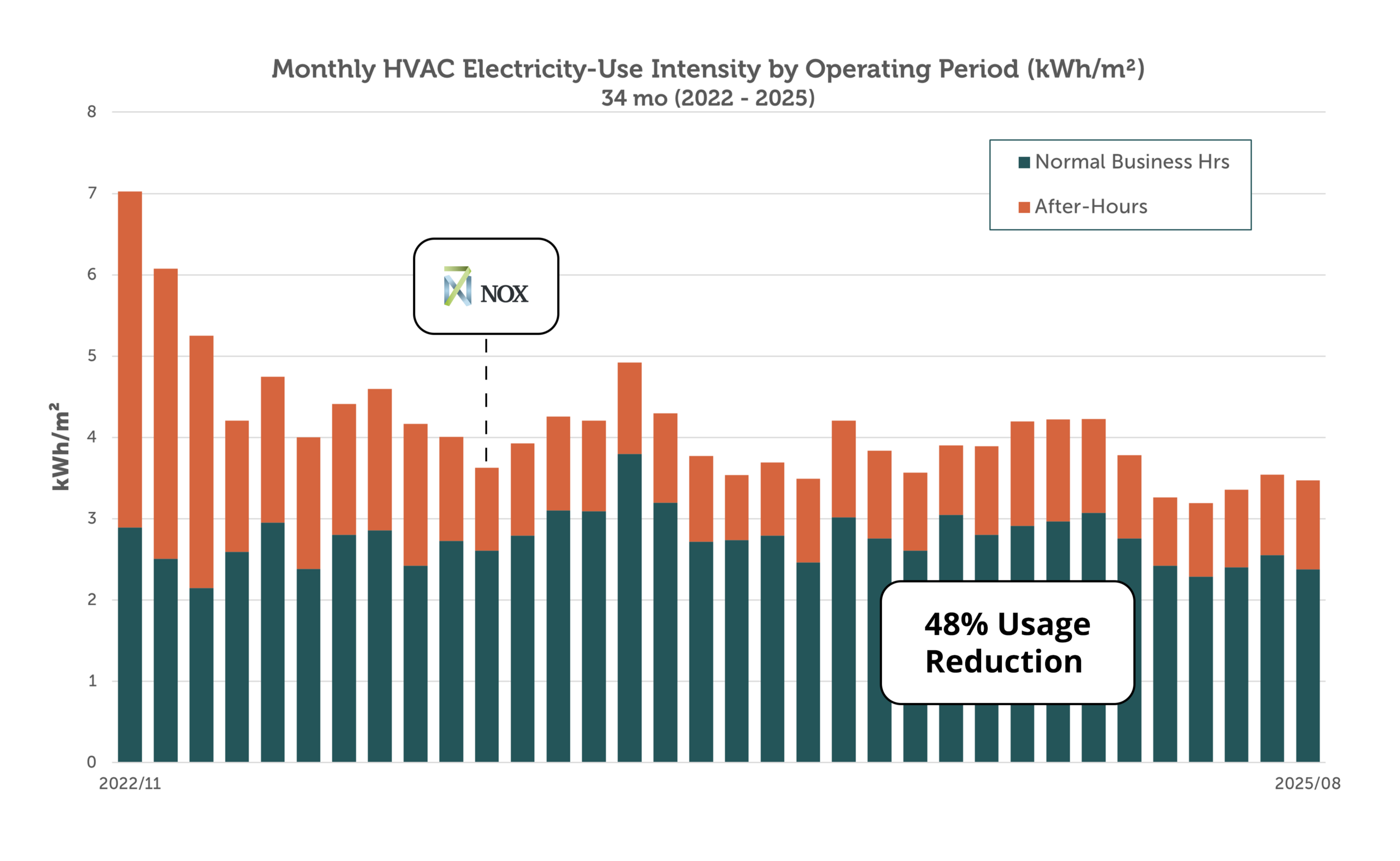
48% reduction in after-hours HVAC intensity. 34 months of data.
One Auckland office building. Read the proof.
The Gap in Your Reporting
ENERGY STAR, LEED, GRESB, and BOMA BEST track whole-building performance. None of them track this.
When a tenant presses a button and HVAC runs for four hours in an empty office, that energy doesn’t disappear — it shows up in your whole-building numbers, averaged out, attributed to no one.
Major sustainability frameworks don’t require landlords or tenants to isolate after-hours HVAC bookings as a named, reportable metric. So the waste stays invisible. The behavior goes unchallenged. And the cost gets spread across everyone.
That’s the after-hours blind spot. And it’s correctable — without a capital retrofit, without penalizing tenants, and without waiting for a new mandate.

Download free:
The After-Hours Blind Spot
The white paper on the sustainability metric commercial buildings aren’t tracking — and what a 34-month proof case shows about closing it.
The research behind this white paper was recently featured in BUILDINGS Magazine. [Read the article]
We don’t sell your data.